Sourcing cardamom powder bulk Indonesia? Get expert answers to the 10 most common importer questions — from specs and MOQ to Halal certification and lead times..
1. What Is the Standard Quality Specification for Cardamom Powder?
When evaluating any West Java spice supplier, the first document to request is the Certificate of Analysis (COA). For food grade cardamom powder, industry-accepted benchmarks include:
ParameterAcceptable RangeMoisture Content≤ 10%Total Ash≤ 8%Volatile Oil Content≥ 5% (GC method)Mesh Size60–80 mesh (standard); 100 mesh availableMicrobiological (Total Plate Count)≤ 10,000 CFU/gHeavy Metals (Lead)≤ 0.1 ppm (EU standard)
A reliable supplier will provide full COA with every batch, backed by a third-party lab or an in-house HACCP-certified facility. Always cross-reference the COA date with the production date — cardamom’s volatile oil degrades quickly, so freshness matters.
2. Is Indonesian Cardamom Powder Halal Certified?
Yes — and this is one of the most common compliance questions we receive, particularly from buyers in the Gulf Cooperation Council (GCC) countries, Southeast Asia, and Muslim-majority markets in Europe.
Reputable Indonesian exporters carry Halal certification issued by MUI (Majelis Ulama Indonesia), the national authority recognised globally including by JAKIM (Malaysia), ESMA (UAE), and SFDA (Saudi Arabia). When requesting documentation, ask specifically for:
- MUI Halal Certificate with valid expiry date
- Halal scope statement confirming the powder form is covered
- Chain-of-custody declaration from raw material sourcing through milling
For clean label ingredient procurement where both Halal and non-GMO status are required, Indonesian cardamom qualifies naturally — no genetic modification has been applied to Elettaria cardamomum cultivation in Jawa Barat.
3. What Is the Minimum Order Quantity (MOQ) and How Is It Packaged?
MOQ for cardamom powder bulk Indonesia from professional exporters typically starts at 1 MT (metric tonne). Smaller trial orders of 50–100 kg are sometimes available for first-time buyers at sample pricing.
Standard packaging options:
- 25 kg kraft paper bags with inner PE liner (most common for bulk spice powder wholesale)
- 10 kg vacuum-sealed foil pouches (preferred for premium or retail-ready supply chains)
- Custom OEM packaging available from 500 g retail sachets for private-label buyers
For HORECA ingredient supplier requirements, 5 kg and 10 kg catering packs can be arranged upon request. All packaging is food grade and compliant with EU Food Contact Materials Regulation (EC) No. 1935/2004.
4. What Certifications Should I Expect Beyond Halal?
A professional Indonesian spice powder exporter should be able to supply the following documentation for every shipment:
- Certificate of Analysis (COA) — batch-specific lab results
- Phytosanitary Certificate — issued by Indonesia’s Ministry of Agriculture (BARANTAN)
- Certificate of Origin — from the Chamber of Commerce, required for preferential tariff access under ASEAN FTA and CEPA agreements
- Halal Certificate — MUI-issued, as above
- HACCP compliance documentation — covering the processing facility
- Health Certificate (for EU imports) — where required by destination country
Buyers importing into the EU should also verify whether the supplier has registered under the EU General Food Law traceability requirements. For the US market, FDA Prior Notice is mandatory for food shipments — confirm your supplier is familiar with this process.
5. How Do I Verify Volatile Oil Content Before I Order?
Volatile oil content is the primary quality driver for cardamom powder — it determines aroma intensity, which directly affects your end product’s performance. Here’s how serious buyers verify it:
Step 1 — Request the COA with GC (Gas Chromatography) Method: This shows total volatile oil percentage and the key compounds (1,8-cineole and α-terpinyl acetate). Premium Indonesian cardamom typically shows 1,8-cineole at 25–45% and α-terpinyl acetate at 30–45% of the volatile fraction.
Step 2 — Order a Pre-Shipment Sample: Any credible West Java spice supplier will ship 200–500 g samples at cost before bulk orders. Test these at your own accredited lab.
Step 3 — Include Quality Specs in Your Purchase Contract: Specify the minimum volatile oil percentage as a contractual requirement, with re-test provisions if the COA on arrival deviates beyond ±0.5%.
This three-step verification process protects both the buyer and builds long-term supplier accountability.
6. What Are the Lead Times for Bulk Orders?
Lead times for cardamom powder bulk Indonesia depend on order size and processing requirements:
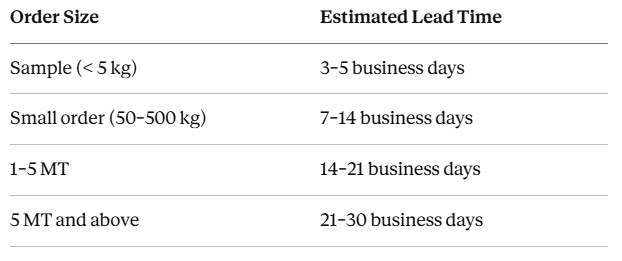
Lead times include milling, packaging, quality inspection, and export documentation preparation. Shipping transit time is additional — typically 18–25 days by sea to the Gulf, 25–35 days to European ports, and 30–40 days to the US East Coast.
For buyers with seasonal demand peaks, it is advisable to place orders 6–8 weeks before the required delivery date. Establish a forecast agreement with your supplier to secure capacity during harvest season (Indonesia’s cardamom harvest runs June–August).
7. How Should Cardamom Powder Be Stored, and What Is the Shelf Life?
Improper storage is the single biggest cause of quality loss in cardamom powder. Volatile oils — the source of flavour and value — dissipate rapidly under heat, light, and humidity.
Recommended storage conditions:
- Temperature: 15–25°C (away from direct sunlight)
- Relative Humidity: ≤ 65%
- Store away from strong odours (cardamom absorbs aromas)
Shelf life:
- In original sealed packaging: 24 months from production date
- Once opened: consume within 6 months; reseal immediately after use
For specialty food importers and distributors, vacuum-sealed inner bags extend shelf life significantly. When purchasing bulk spice powder wholesale, always check the production date on the COA — a batch milled more than 3 months ago is selling into its freshness window.
8. Is Indonesian Cardamom Organic Certified?
Organic cardamom powder from Indonesia is available, but supply is limited and requires advance planning. Certified organic product comes with:
- USDA NOP certification (for US market)
- EU Organic Regulation (EC) 834/2007 compliance certificate (for EU market)
- LSPO or Control Union certification (widely recognised in the Gulf and Asia)
Organic cardamom powder from Indonesia typically commands a 15–25% price premium over conventional food grade product. If your application requires an organic claim or clean label ingredient positioning, confirm with your supplier that the organic certificate covers the powder processing facility — not just the raw material farm.
Conventional (non-organic) product is far more widely available at scale and meets all food grade and HACCP compliant ingredient standards for most industrial and HORECA applications.
9. What Is the FOB Price Range, and What Affects Pricing?
FOB Indonesia pricing for food grade cardamom powder varies based on:
- Grade (organic vs. conventional; volatile oil content tier)
- Order volume (per-kg price typically decreases 10–20% from 1 MT to 5 MT+)
- Packaging (standard bulk vs. custom OEM)
- Harvest season (post-harvest Q3 pricing is typically most competitive)
As a general reference, conventional food grade cardamom powder at 60 mesh, FOB Indonesian port, has traded in the range of USD 8–15/kg depending on the above variables. Organic certified product adds the premium mentioned above.
Always obtain a formal quotation tied to a specific COA and spec sheet — verbal price indications without spec documentation are unreliable for budgeting purposes. Ask for pricing valid for 30 days minimum, in writing.
10. How Do I Start the Sourcing Process with a New Supplier?
For buyers new to how to import spices from Indonesia, here is a proven framework:
- Send a sourcing inquiry with your target spec (mesh size, volatile oil minimum, certification requirements, destination country)
- Request COA and certifications from the supplier’s most recent batch before any commercial discussion
- Order a paid sample (100–200 g minimum) and have it tested at an accredited lab in your country
- Negotiate terms — MOQ, pricing, payment terms (T/T, LC), lead time, and quality dispute resolution clause
- Place a trial order (typically 1 MT) to verify logistics, documentation, and product performance end-to-end
- Scale based on results — establish a rolling forecast agreement for ongoing supply
A supplier that hesitates at any step — especially steps 2 or 3 — is a risk signal. Established exporters welcome pre-qualification because it builds long-term, low-friction partnerships.